
From “one-size-fits-all” to “right therapy, right patient”: why this moment in personalized medicine feels different
VOICES FROM THE WORLD
For decades, medicine has been moving steadily toward a simple goal: match the best therapy to the biology of the individual patient, not the average patient. That idea is precision medicine, and in cancer especially, it has already changed lives.
But we all know the frustrating reality: even when we have good drugs, predicting which one will work for which person, remains one of the most significant challenges in healthcare. Tumors evolve, patients differ, biology is noisy. Therefore, the current evidence we rely on in clinical trials often can’t cover every molecular subtype, comorbidity, or treatment history.
This is where a new convergence is creating genuine momentum: AI + multi-omics data + a growing universe of available therapies. It’s why organizations like One Patient One Cure find now is the time to focus on building tools that can help clinicians and patients navigate complexity with higher confidence, especially for people who don’t have time for trial-and-error.
Multi-omics: seeing the whole system, not just one layer
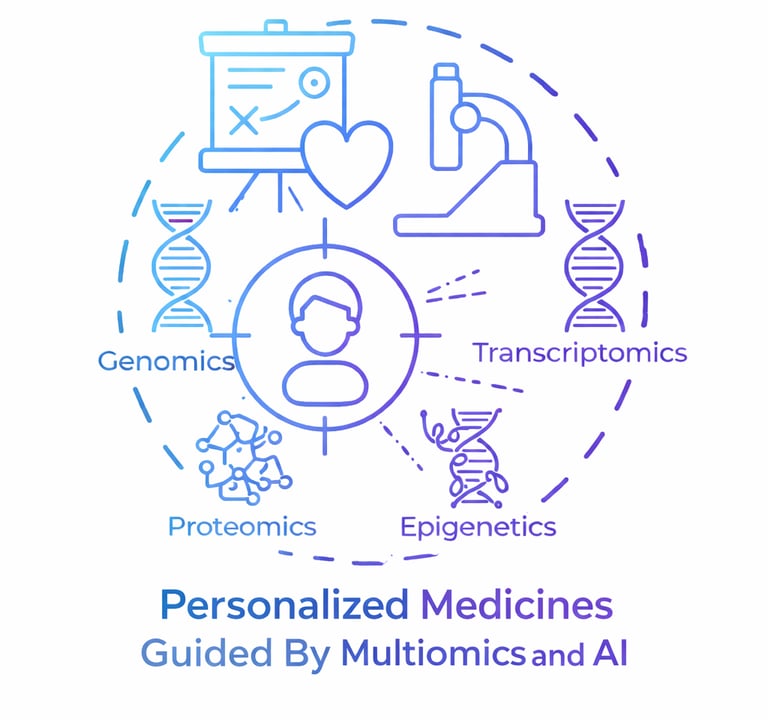
When we say “omics,” we’re talking about measurements that capture different layers of biology:
Genomics: DNA changes (mutations, copy number changes, structural variants)
Transcriptomics: RNA expression (what genes are “on” or “off”)
Proteomics: Protein levels and signaling activity (what pathways are actually firing)
Metabolomics, epigenomics, spatial biology, and more
Cancer is rarely a single mutation problem; it’s a network problem. That’s why multi-omics can be so powerful. It can reveal the functional state of disease, not just the genetic blueprint. Large academic efforts have shown that adding protein-level data can sharpen drug-response signals that transcriptomics or genomics alone can miss.
AI: turning high-dimensional data into actionable predictions
The challenge with multi-omics isn’t generating data, it’s interpreting it fast enough to help real patients. AI (especially modern machine learning and deep learning) can integrate thousands to millions of features, detect complex nonlinear patterns, and generate probabilistic predictions like “this patient’s tumor biology resembles profiles that respond to Drug A + Drug B.”
This is increasingly viewed as one of the most practical roles for AI in precision oncology: integrating multi-modal, multi-omics signals to support treatment selection with appropriate validation, transparency, and clinical oversight.
Importantly, One Patient One Cure describes its mission in exactly this direction—using AI with multi-omics data to better predict drug response for individual patients.
That’s the heart of the promise: not “AI replaces clinicians,” but AI helps clinicians see patterns no human could reliably compute and helps patients avoid losing precious time on therapies unlikely to work.
“Baby KJ”: a proof-of-possibility for true personalization
If you want a single case study that captures the excitement (and the urgency) of personalized medicine, it’s the story of “Baby KJ.”
In 2025, clinicians and scientists at Children’s Hospital of Philadelphia (CHOP) and Penn Medicine reported the first patient treated with a personalized in vivo CRISPR gene-editing therapy, a bespoke therapy, designed for an infant with severe CPS1 deficiency, a life-threatening urea cycle disorder.
A few details make this case extraordinary:
The team identified KJ’s specific variant soon after birth and developed a patient-specific base-editing therapy delivered to the liver via lipid nanoparticles (LNPs).
They did this within about six months, with first dosing reported in February 2025 (followed by additional doses in March and April 2025).
The results were published in The New England Journal of Medicine and presented at the ASGCT annual meeting.
Industry partners supported rapid development/manufacturing; Aldevron describes leveraging mRNA and gRNA manufacturing platforms, LNP technology, and coordinated regulatory execution in the effort.
This wasn’t “personalized” in the common marketing sense. It was personalized in the literal sense, a therapy built for one human being.
And while Baby KJ’s story is about a rare metabolic disease, not cancer, it matters for oncology because it demonstrates something profound: with the right platform, infrastructure, and collaboration, “N-of-1” medicine can move on a clinically meaningful timeline.
The next leap: personalized oncology using existing therapies—faster than bespoke drugs
Cancer presents a different challenge than a single-gene disorder. A tumor isn’t one static mutation: it’s a living ecosystem. We may not always be able (or need) to build a brand-new therapy for each patient, but there’s an enormous opportunity hiding in plain sight. We already have a massive library of approved and late-stage therapies. Targeted inhibitors, antibody–drug conjugates, immunotherapies, epigenetic drugs, cell therapies, radiopharmaceuticals, and more.
The bottleneck is matching, not inventing. For many patients, the urgent question is: Which existing option is most likely to work for my tumor biology?
This is where AI + multi-omics becomes a practical engine for personalization:
Profile the patient’s tumor (multi-omics when possible; at minimum genomics + transcriptomics, ideally with proteomics in select contexts).
Use AI models trained on large pharmacogenomic and clinical datasets to estimate sensitivity patterns (including combinations).
Prioritize therapies that already exist, including, where appropriate, rational off-label candidates while generating evidence through registries, prospective studies, and real-world validation.
That last step matters: off-label use can be clinically appropriate, but it must be grounded in evidence, safety, and careful clinician judgment. The vision is not “AI says take Drug X,” but rather: AI helps surface the most biologically plausible options, and then clinicians evaluate feasibility, safety, and supporting data.
Baby KJ’s story shows what’s possible when science, medicine, and manufacturing align around one patient. To bring that spirit into oncology broadly, we need the ecosystem to get better at a few things:
Data quality and standardization across omics modalities (garbage in, garbage out)
Clinical-grade validation: prospective trials, pragmatic studies, and real-world performance monitoring
Interpretability and trust: clinicians need to understand why a model recommends something
Speed: results must arrive fast enough to matter for real patients
Equity: personalization can’t become a luxury service available only to a few
This is why “one patient one cure” work is not a niche: it’s a forcing function. When you build for the hardest case (one person, one timeline, one chance), you end up inventing workflows that can eventually help many.
What’s exciting right now is not just any single technology, AI, proteomics, or CRISPR. It’s the sense that we’re finally learning how to connect them into an end-to-end system that can answer the question patients ask every day:
Baby KJ’s team showed that truly personalized therapies can be built in months when the stakes demand it.
Organizations like One Patient One Cure are pushing toward a future where prediction rather than guesswork guides therapy selection by integrating AI with multi-omics signals.
If we get this right, the long-term impact is bigger than any single breakthrough: fewer failed treatments, faster responses, smarter use of existing drugs, and a healthcare system that treats patients as individuals because biologically, that’s what they are.
Call to Action: Join Us in Making Precision Medicine Real
Our vision of every patient receiving the therapy that is most likely to help them is ambitious, but it’s achievable with collective support. If you believe in the power of personalized medicine, here’s how you can help:
Donate
Your contributions propel research, data infrastructure, and AI development that can accelerate precision oncology for patients who need it now.
https://onepatientonecure.org/donate
Partner With Us
We are actively seeking collaborations with academic centers, clinical research organizations, bioinformatics partners, and technology innovators to advance the science and clinical application of predictive models.
https://onepatientonecure.org/partners-and-collaborators
Advocate for Patients
Patient advocacy is essential to accelerate access, widen awareness of precision strategies, and influence policy that favors individualized approaches. Encourage clinicians and institutions to consider data-driven personalized strategies for real-world patients.
Together, we can transform treatment decision-making—reducing uncertainty, shortening therapy cycles, and giving each patient the best possible shot at a cure.
Follow us on social media
© 2026 One Patient One Cure . All rights reserved.
Contact us
Email:
contact@onepatientonecure.org
Mail address:
360 Riverway Unit 24
Boston, MA 02115.
Stay updated on our progress